Darfur - Jihad perverted
From a strictly religious standpoint, the killing of the Christian and or animist population of Southern Sudan could be interpreted as part of the obligation of pious Muslims to fight the infidels. But there is now enough evidence that religious zeal is not the principal motive for the activities of the milices supported by the government in Khartum in Darfur.The fossile fuel and mineral resources below the surface are the most important one, and no one knows who will finally take profit from the dirty work of the milices. All this might be trivial if there was not the silence with which religious authorities and intellectuals in the islamic world ahve reacted to the Darfur tragedy so far.
It would greatly enhance the credibility of the religious and intellectual elite of the muslim community if it's most prominent exponents could decide to take action against the Khartum government, beyond the closed circles of the United Nations. No doubt, the victims of the United States war against Iraq and the sufferings of the Chechen population on the hand of Russia both contribute greatly to a desire for revenge throughout the Muslim community, but this is a different story, this is Africa, a continent that has already suffered too much from foreign domination, be it
slavery, colonial or postcolonial oppression, a continent without defense.
A strong word from Muslim leaders on Darfur is overdue.
Thursday, March 22, 2007


Thursday, March 08, 2007
"Monarchie bananière" et "Cheval noir"
Aujourd'hui, la Neue Zürcher Zeitung décrit François Bayrou comme "cheval noir" qui aurait échappé au propriétaire de son écurie, l'UDF (seul mouvement libéral de la France) et plus particulièrement à l'ancien Président de la République, Giscard d'Estaing. Il y a deux raisons pour Giscard de se fâcher contre le "cheval noir":
a) Etant ENArque lui-même,il y lui-même toujours été un membre proéminent de la "monarchie bananière" apostrophiée hier sur France Culture par la Verte Corinne Lepage (dont ont peu admirer le courage du soutenir un libéral et d'afficher sa conviction qu'écologiee et économie de marché ne sont pas en contradiction irréparable)
b) Bayrou propose un projet simplifié pour la Constitution Européenne dont Giscard a été le père spirituel...
Vous trouverez les sites web de Bayrou et de Corinne Lepage dans la liste des liens.
"Banana Monarchy" and "Black Horse"
Yesterday, on French radio station "France Culture", a refreshing interview with one of the less known dozens of candidates for the French presidential election, Corinne Lepage. This outspoken lady has already made public her preference for the liberal François Bayrou who at present is classified third in the presidential race behind the official big party candidates Nicolas Sarkozy and Ségolène Royal.
While openly addressing ecological subjects, she refuses to accept the wide-spread view that market economy and ecological objectives are incompatible. Why does she take sides at this early stage of the campaign`with a liberal outsider? She explains that France has become a "banana monarchy" which means that the power centers of the state are in the hands of an extremely restricted and inbred elite of men and women who have started their carreer as students at the ENA (Ecole Nationale d'Administration), the so-called "Enarchs", with little or no contact with the economic and societal reality of the population.
Her programme is worth reading even for those who do not share her views on nuclear power plants. You will find it along with the one of François Bayrou on the link list.
Today, the Neue Zürcher Zeitung describes François Bayrou as "Black Horse" escaping control by his owner (former French President Giscard d'Estaing and the "Union pour la Démocratie Française UDF", the only serious liberal movement in France). It is clear that Giscard d'Estaing ist angry about the "black horse" for two simple reasons:
a) Giscard has always been a prominent "ENArque" and member of the "banana monarchy" nomenclatura, and
b) Bayrou is suggesting a new, simplified project for the European Constitution the core programme of which had been masterminded by Giscard himself...
Aujourd'hui, la Neue Zürcher Zeitung décrit François Bayrou comme "cheval noir" qui aurait échappé au propriétaire de son écurie, l'UDF (seul mouvement libéral de la France) et plus particulièrement à l'ancien Président de la République, Giscard d'Estaing. Il y a deux raisons pour Giscard de se fâcher contre le "cheval noir":
a) Etant ENArque lui-même,il y lui-même toujours été un membre proéminent de la "monarchie bananière" apostrophiée hier sur France Culture par la Verte Corinne Lepage (dont ont peu admirer le courage du soutenir un libéral et d'afficher sa conviction qu'écologiee et économie de marché ne sont pas en contradiction irréparable)
b) Bayrou propose un projet simplifié pour la Constitution Européenne dont Giscard a été le père spirituel...
Vous trouverez les sites web de Bayrou et de Corinne Lepage dans la liste des liens.
"Banana Monarchy" and "Black Horse"
Yesterday, on French radio station "France Culture", a refreshing interview with one of the less known dozens of candidates for the French presidential election, Corinne Lepage. This outspoken lady has already made public her preference for the liberal François Bayrou who at present is classified third in the presidential race behind the official big party candidates Nicolas Sarkozy and Ségolène Royal.
While openly addressing ecological subjects, she refuses to accept the wide-spread view that market economy and ecological objectives are incompatible. Why does she take sides at this early stage of the campaign`with a liberal outsider? She explains that France has become a "banana monarchy" which means that the power centers of the state are in the hands of an extremely restricted and inbred elite of men and women who have started their carreer as students at the ENA (Ecole Nationale d'Administration), the so-called "Enarchs", with little or no contact with the economic and societal reality of the population.
Her programme is worth reading even for those who do not share her views on nuclear power plants. You will find it along with the one of François Bayrou on the link list.
Today, the Neue Zürcher Zeitung describes François Bayrou as "Black Horse" escaping control by his owner (former French President Giscard d'Estaing and the "Union pour la Démocratie Française UDF", the only serious liberal movement in France). It is clear that Giscard d'Estaing ist angry about the "black horse" for two simple reasons:
a) Giscard has always been a prominent "ENArque" and member of the "banana monarchy" nomenclatura, and
b) Bayrou is suggesting a new, simplified project for the European Constitution the core programme of which had been masterminded by Giscard himself...
Wednesday, March 07, 2007
Fortune-Building in Switzerland and the reinvention of dynasties of the Habsburg type
My post on Swiss Federal minister of justice Christoph Blocher and his critique of NOVARTIS CEO and chairman of the board Daniel Vasella has provoked interesting comments. An anonymous commentator whose text I will not publish in extenso for reasons of privacy protection writes to me:
"What astounds me about HBM (i.e. Henri B.Meier, former finance chief of ROCHE and HBM Partner AG, Zurich, respectively, see http://www.moneyhouse.ch/u/pub/hbm_partners_ag_CH-020.3.024.334-3.htm - the editor ), Ebner & Blocher: No one in this country is interested in the real origin of Blocher's fortune (it can quite obviously not be from EMS) and no one in this country seems to be interested in the origin of HBMs astronomical financial profits @ Roche back in the early nineties either, nor in the financial shambles he left, earlier this decade. ... Despite the vast amount of socialist oriented journalists, writing here. An omertà that reminds one of the Craxi Italy and of the former PM there, don't you think?"
My post on Swiss Federal minister of justice Christoph Blocher and his critique of NOVARTIS CEO and chairman of the board Daniel Vasella has provoked interesting comments. An anonymous commentator whose text I will not publish in extenso for reasons of privacy protection writes to me:
"What astounds me about HBM (i.e. Henri B.Meier, former finance chief of ROCHE and HBM Partner AG, Zurich, respectively, see http://www.moneyhouse.ch/u/pub/hbm_partners_ag_CH-020.3.024.334-3.htm - the editor ), Ebner & Blocher: No one in this country is interested in the real origin of Blocher's fortune (it can quite obviously not be from EMS) and no one in this country seems to be interested in the origin of HBMs astronomical financial profits @ Roche back in the early nineties either, nor in the financial shambles he left, earlier this decade. ... Despite the vast amount of socialist oriented journalists, writing here. An omertà that reminds one of the Craxi Italy and of the former PM there, don't you think?"
Monday, February 26, 2007
Blocher's U-turn from nationalism to stockholder (or national?) socialism
Federal Councillor Christoph Blocher is a fine strategist with a complete amnesia for his own entrepreneurial carreer. By attacking NOVARTIS CEO Daniel Vasella - in an interview with the Neue Zürcher Zeitung am Sonntag, February 25, 2007 - and presenting himself as an advocate for stockholder rights, he forgets how he himself did his tricks as a young poor farmer and son of a protestant clergyman to become first CEO of EMS Chemie, a fine-chemicals enterprise domciliated at Domat-Ems in the Canton of Grisons and then get complete control of what is now EMS-Chemie Holding and a vast financial empire which he handed over to his children when he was elected to the Swiss Federal Council. A fierce patriot with a perfect sensorium and rhetoric to allure the electorate from the extreme right , he uses his power as minister of justice to remodel the judicial system of Switzerland according to his own ideas, which always come as a surprise to those who do not know him. His newest U-turn, presented as an indirect critique of NOVARTIS boss Vasella, has been well designed to please the notoriously socalist electorate of the Canton of Basel-Stadt and to help his own Swiss People's Party (SVP) that has had a difficult stand in that tiny city-republic and headquarter of ROCHE and NOVARTIS so far.
It is far from certain if the notoriously minoritarian liberals will be able to stem the tide and prevent Blocher's party from sucking them up in the national parliamentary elections due in autumn 2007.
The fusion of nationalism and socialism, Blocher style, is well under way in Switzerland.
Federal Councillor Christoph Blocher is a fine strategist with a complete amnesia for his own entrepreneurial carreer. By attacking NOVARTIS CEO Daniel Vasella - in an interview with the Neue Zürcher Zeitung am Sonntag, February 25, 2007 - and presenting himself as an advocate for stockholder rights, he forgets how he himself did his tricks as a young poor farmer and son of a protestant clergyman to become first CEO of EMS Chemie, a fine-chemicals enterprise domciliated at Domat-Ems in the Canton of Grisons and then get complete control of what is now EMS-Chemie Holding and a vast financial empire which he handed over to his children when he was elected to the Swiss Federal Council. A fierce patriot with a perfect sensorium and rhetoric to allure the electorate from the extreme right , he uses his power as minister of justice to remodel the judicial system of Switzerland according to his own ideas, which always come as a surprise to those who do not know him. His newest U-turn, presented as an indirect critique of NOVARTIS boss Vasella, has been well designed to please the notoriously socalist electorate of the Canton of Basel-Stadt and to help his own Swiss People's Party (SVP) that has had a difficult stand in that tiny city-republic and headquarter of ROCHE and NOVARTIS so far.
It is far from certain if the notoriously minoritarian liberals will be able to stem the tide and prevent Blocher's party from sucking them up in the national parliamentary elections due in autumn 2007.
The fusion of nationalism and socialism, Blocher style, is well under way in Switzerland.
Sunday, February 25, 2007
Muammar Al Gadhafi's Best Friends
are the Swiss. 50% of their importation of crude oil is from Libya. While the Swiss are bickering at each other over the question whether they will need nuclear power plants from 2020 on, they heat their homes and they drive their cars with fuel from a dictatorship of exemplary cruelty (see my post of december 12, 2006 on "le jugement de Tripoli")
A question: would a boycot of Libyan oil and the demand for oil from countries where the most basic human rights are respected fall into the category of racist, antiislamic ideologies?
Les meilleurs amis de Mouammar El Gaddafi
ce sont les Suisses. 50% de leurs importantions de pétrole brut proviennet de la Libye. Pendant qu'ils s'engueulent entre eux pour savoir s'ils auront besoin de centrales nucléaires à partir de l'an 2020, ils chauffent leurs maisons et ils conduisent leurs bagnoles avec du fuel qui provient d'une dictature d'une cruauté exemplaire (voir mon texte du 12 décembre 2006 "Le jugement de Tripoli...")
Une question: Un boycot du pétrole libyen et la demande d'importer du fuel de pays où les droits fondamentaux sont respectés tomberaient-il sous la catégorie d'une idéologie raciste ou antiislamique?
Die besten Freunde Muammar Al Gadhafis
sind die Schweizer. 50% ihrer Rohölimporte stammen aus Libyen. Während sie heftig darüber streiten, ob sie ab 2020 Kernkraftwerke benötigen werden, heizen sie
ihre Häuser und fahren sie ihre Wagen mit Sprit der aus einer Diktatur von exemplarischer Grausamkeit stammt (man vergleiche mit meinem Post vom 12.Dezember 2006 über den Prozess von Tripoli).
Eine Frage: müsste ein Boykott libyschen Erdöls und die Forderung, Öl aus Ländern zu importieten, in denen die fundamentalen Menschenrechte respektiert werden, alsAusdruck einer rassistischen oder antiislamischen Ideologie gewertet werden?
I migliori amici di Muammar El Gaddafi
sono i Svizzeri. Il 50 percento delle loro importazioni di petroglio crudo vengono dalla Libia. Mentre che litigano con grande intensità sul problema se avranno bisogno di centrali nucleari nel 2020, riscaldano i loro appartamenti e guidano le loro vetture con gasoglio o benzina che proviene da una dittarura di crudeltà straordinaria (cf. il mio post del 12 dicembre 2006 "le jugement de Tripoli...")
Una domanda: il fatto di domandare un boicotto dell'importazione di petroglio dalla Libia dovrebbe essere qualificato come l'espressione di un'ideologia razzista o antiislamica?
are the Swiss. 50% of their importation of crude oil is from Libya. While the Swiss are bickering at each other over the question whether they will need nuclear power plants from 2020 on, they heat their homes and they drive their cars with fuel from a dictatorship of exemplary cruelty (see my post of december 12, 2006 on "le jugement de Tripoli")
A question: would a boycot of Libyan oil and the demand for oil from countries where the most basic human rights are respected fall into the category of racist, antiislamic ideologies?
Les meilleurs amis de Mouammar El Gaddafi
ce sont les Suisses. 50% de leurs importantions de pétrole brut proviennet de la Libye. Pendant qu'ils s'engueulent entre eux pour savoir s'ils auront besoin de centrales nucléaires à partir de l'an 2020, ils chauffent leurs maisons et ils conduisent leurs bagnoles avec du fuel qui provient d'une dictature d'une cruauté exemplaire (voir mon texte du 12 décembre 2006 "Le jugement de Tripoli...")
Une question: Un boycot du pétrole libyen et la demande d'importer du fuel de pays où les droits fondamentaux sont respectés tomberaient-il sous la catégorie d'une idéologie raciste ou antiislamique?
Die besten Freunde Muammar Al Gadhafis
sind die Schweizer. 50% ihrer Rohölimporte stammen aus Libyen. Während sie heftig darüber streiten, ob sie ab 2020 Kernkraftwerke benötigen werden, heizen sie
ihre Häuser und fahren sie ihre Wagen mit Sprit der aus einer Diktatur von exemplarischer Grausamkeit stammt (man vergleiche mit meinem Post vom 12.Dezember 2006 über den Prozess von Tripoli).
Eine Frage: müsste ein Boykott libyschen Erdöls und die Forderung, Öl aus Ländern zu importieten, in denen die fundamentalen Menschenrechte respektiert werden, alsAusdruck einer rassistischen oder antiislamischen Ideologie gewertet werden?
I migliori amici di Muammar El Gaddafi
sono i Svizzeri. Il 50 percento delle loro importazioni di petroglio crudo vengono dalla Libia. Mentre che litigano con grande intensità sul problema se avranno bisogno di centrali nucleari nel 2020, riscaldano i loro appartamenti e guidano le loro vetture con gasoglio o benzina che proviene da una dittarura di crudeltà straordinaria (cf. il mio post del 12 dicembre 2006 "le jugement de Tripoli...")
Una domanda: il fatto di domandare un boicotto dell'importazione di petroglio dalla Libia dovrebbe essere qualificato come l'espressione di un'ideologia razzista o antiislamica?
Thursday, February 22, 2007
Quo usque tandem, Bertinotti, abutere patientia nostra?
The Italian Senate has failed to approve the foreign policy program of the government Prodi by 2 votes (158 instead of the 160 necessary for the qualified majority) and one again the responsible force behind this defeat is Bertinotti's Rifondazione Communista. Much as in the final crisis of the German Weimar Republic, a communist party that plays into the hands of the fascists. In Weimar, the communists - on order from Moscow - treated the social democrats as "Sozialfaschisten" and opened the way for Hitler's takeover. The most outrageous element this time is the fact that Romano Prodi's foreign policy has tried hard to redress the the mess initiated by Berlusconi's whole-hearted approval of the G.W.Bush's Iraq adventure, and to guarantee a say of Italy in the chorus of international concertation on security policies.
Italy's new Catilina is a man with a classical educational background, Fausto Bertinotti, and he should well understand the quotation above...
The Italian Senate has failed to approve the foreign policy program of the government Prodi by 2 votes (158 instead of the 160 necessary for the qualified majority) and one again the responsible force behind this defeat is Bertinotti's Rifondazione Communista. Much as in the final crisis of the German Weimar Republic, a communist party that plays into the hands of the fascists. In Weimar, the communists - on order from Moscow - treated the social democrats as "Sozialfaschisten" and opened the way for Hitler's takeover. The most outrageous element this time is the fact that Romano Prodi's foreign policy has tried hard to redress the the mess initiated by Berlusconi's whole-hearted approval of the G.W.Bush's Iraq adventure, and to guarantee a say of Italy in the chorus of international concertation on security policies.
Italy's new Catilina is a man with a classical educational background, Fausto Bertinotti, and he should well understand the quotation above...
Thursday, February 15, 2007
More answers than questions this time?I am grateful to Epicure and Rossi for their answers.
Now here is my own position:
1. Q: Is spirituality compatible with modern scientific research?
A: Yes, as long as the person's spiritual disposition does not interfere with
his/her rational thinking, his/her honesty in methodological and technical
procedures and documentation of results, and his/her interpretation of
results. Spirituality in this case will have an influence on the motivation
of the researcher for a particular discipline or a specific research theme,
but the risk that it will interfere with the quality of the reserach is
comparable to the risk presented by financial support of research from private
enterprises or from state.
2. Q: Does spirituality interfere with the capacity to critical rational thinking?
A: No, if the conditions formulated in #1. are respected, i.e. the capacity
and readiness of the individal with a spiritual disposition to separate this
disposition and rational thinking
3. Q: Is spirituality necessary for religious orientation?
A: No. Religious orientation may be chosen on a purely rational basis or as a
means to reduce social and/or ethical conflicts in every-day life
4. Q: Is religion a technical substitute for lacking natural spirituality?
A: As a logical consequence of my answer to #3.: Yes, I am convinced that religion
may have this function, and that religious leaders consciously use and abuse
this element.
5. Q: Is spirituality compatible with atheism?
A: Yes, once again under the conditions described in #1. and #2. The conscious
self might decide to opt for atheism as an alternative to opting for a
religious orientation, and the spiritual disposition might be the
motivator to decide that way.
Now for Rossi's question on the importance of religion for liberal democracy:
My answer is clear: the history of modern democracies (e.g. the U.S.A.) have shown that religious orientations - and in particular multiple religious orientations, even those of sectarian character - might be helpful for the development of liberal democratic decision processes, for the simple reason that they can help people understand the impossibility to change and/or to homogenize personal religious feelings on a societal level, thus facilitating a dialogue "over the fences". In contrast to societies with heterogeneous religious communities, religious monopolies (e.g. Roman Catholicism or Islam) tend to heavily interfere with the development of liberal democratic structures.
This time, the answers seem to prevail over the questions raised. Hopefully to read more answers, and why not, more questions...
Osservatore Profano
Now here is my own position:
1. Q: Is spirituality compatible with modern scientific research?
A: Yes, as long as the person's spiritual disposition does not interfere with
his/her rational thinking, his/her honesty in methodological and technical
procedures and documentation of results, and his/her interpretation of
results. Spirituality in this case will have an influence on the motivation
of the researcher for a particular discipline or a specific research theme,
but the risk that it will interfere with the quality of the reserach is
comparable to the risk presented by financial support of research from private
enterprises or from state.
2. Q: Does spirituality interfere with the capacity to critical rational thinking?
A: No, if the conditions formulated in #1. are respected, i.e. the capacity
and readiness of the individal with a spiritual disposition to separate this
disposition and rational thinking
3. Q: Is spirituality necessary for religious orientation?
A: No. Religious orientation may be chosen on a purely rational basis or as a
means to reduce social and/or ethical conflicts in every-day life
4. Q: Is religion a technical substitute for lacking natural spirituality?
A: As a logical consequence of my answer to #3.: Yes, I am convinced that religion
may have this function, and that religious leaders consciously use and abuse
this element.
5. Q: Is spirituality compatible with atheism?
A: Yes, once again under the conditions described in #1. and #2. The conscious
self might decide to opt for atheism as an alternative to opting for a
religious orientation, and the spiritual disposition might be the
motivator to decide that way.
Now for Rossi's question on the importance of religion for liberal democracy:
My answer is clear: the history of modern democracies (e.g. the U.S.A.) have shown that religious orientations - and in particular multiple religious orientations, even those of sectarian character - might be helpful for the development of liberal democratic decision processes, for the simple reason that they can help people understand the impossibility to change and/or to homogenize personal religious feelings on a societal level, thus facilitating a dialogue "over the fences". In contrast to societies with heterogeneous religious communities, religious monopolies (e.g. Roman Catholicism or Islam) tend to heavily interfere with the development of liberal democratic structures.
This time, the answers seem to prevail over the questions raised. Hopefully to read more answers, and why not, more questions...
Osservatore Profano
Sunday, February 11, 2007
Monotheism, Atheism and Spirituality
In the Sunday edition of the Neue Zürcher Zeitung (NZZ am Sonntag) two scientists,ther immunologist Beda M. Stadler, from the University of Berne, and the geneticist Dean Hamer, from the National Cancer Institute in Bethesda, Maryland, explain their relationship to religion and spirituality.
Stadler asks for a "Coming Out" of atheists for the Swiss federal elections due in autumn 2007, in order to assure the liberty of scientific research that is constantly challenged by religious fundamentalists.
Hamer, author of a series of publications on genetic determination of behaviour
(e.g. "Rethinking Behaviour Genetics", Science vol. 298,5591:71-72/4 October 2002)
concentrates on the question of the interactions between religion and spirituality.
From the results of his research on the influence of gene VMAT2 on spirituality and the capability of "self transcendence" in individuals, Hamer concludes that spirituality might be a genetic trait useful for survival of the species, but he does not identify a direct link between religion and spirituality.
The central questions that emerges from the positions of both Stadler and Hamer is the following:
1. Is spirituality compatible with modern scientific research?
2. Does spirituality interfere with the capacity to critical rational thinking?
3. Is spirituality necessary for religious orientation?
4. Is religion a technical substitute for those lacking natural spirituality?
5. Is spirituality compatible with atheism?
Osservatore Profano cordially invites the blogger community to answer his questions
In the Sunday edition of the Neue Zürcher Zeitung (NZZ am Sonntag) two scientists,ther immunologist Beda M. Stadler, from the University of Berne, and the geneticist Dean Hamer, from the National Cancer Institute in Bethesda, Maryland, explain their relationship to religion and spirituality.
Stadler asks for a "Coming Out" of atheists for the Swiss federal elections due in autumn 2007, in order to assure the liberty of scientific research that is constantly challenged by religious fundamentalists.
Hamer, author of a series of publications on genetic determination of behaviour
(e.g. "Rethinking Behaviour Genetics", Science vol. 298,5591:71-72/4 October 2002)
concentrates on the question of the interactions between religion and spirituality.
From the results of his research on the influence of gene VMAT2 on spirituality and the capability of "self transcendence" in individuals, Hamer concludes that spirituality might be a genetic trait useful for survival of the species, but he does not identify a direct link between religion and spirituality.
The central questions that emerges from the positions of both Stadler and Hamer is the following:
1. Is spirituality compatible with modern scientific research?
2. Does spirituality interfere with the capacity to critical rational thinking?
3. Is spirituality necessary for religious orientation?
4. Is religion a technical substitute for those lacking natural spirituality?
5. Is spirituality compatible with atheism?
Osservatore Profano cordially invites the blogger community to answer his questions
Sunday, January 28, 2007
Roger Federer - the exception to the rule
Neither do I play tennis nor am I a tennis fan, but the phenomenon Roger Federer is worth a comment on this blog. This young man appears to be not only a fine technician and a complete athlete, he brings to the world of sports a rare blend of concentration, calm and fairness that demands admiration.
On the occasion of Roger Federer's victory in the Australian Open, Osservatore Profano makes an exception to his rule of continuous questioning and criticizing and extends his congratulations to this extraordinary sportsman.
Neither do I play tennis nor am I a tennis fan, but the phenomenon Roger Federer is worth a comment on this blog. This young man appears to be not only a fine technician and a complete athlete, he brings to the world of sports a rare blend of concentration, calm and fairness that demands admiration.
On the occasion of Roger Federer's victory in the Australian Open, Osservatore Profano makes an exception to his rule of continuous questioning and criticizing and extends his congratulations to this extraordinary sportsman.
Thursday, January 25, 2007
televison and postmodern fascism
When Swiss radio journalist Cornelia Cazis went on air on January 24, 2007 (DRS2) she asked about explanations for growing juvenile violence in Europe. She advanced verbal violence against young people as one important factor and, as an example, she quoted a remark of German Music Star juror Dieter Bohlen the night before on RTL2, as a nervous young contestant had completely failed her performance: "you not only look like shit, you also sing as if the sounds would come from another body opening.."
No wonder, Cornelia Cazis concluded, that young people, especially those who not particularly gifted, react to verbal injury with physical violence...
Remember Nancy Sinatra? "These boots are made for walking... and that's just what they'll do... one of these days these boots are gonna walk all over you..."
When Swiss radio journalist Cornelia Cazis went on air on January 24, 2007 (DRS2) she asked about explanations for growing juvenile violence in Europe. She advanced verbal violence against young people as one important factor and, as an example, she quoted a remark of German Music Star juror Dieter Bohlen the night before on RTL2, as a nervous young contestant had completely failed her performance: "you not only look like shit, you also sing as if the sounds would come from another body opening.."
No wonder, Cornelia Cazis concluded, that young people, especially those who not particularly gifted, react to verbal injury with physical violence...
Remember Nancy Sinatra? "These boots are made for walking... and that's just what they'll do... one of these days these boots are gonna walk all over you..."
Sunday, January 21, 2007
Religion and Collective Suicide
There seems to be a strange relationship between religion and the phenomenon of collective suicide. A singular illustration of this phenomenon is the growing trend to identify and to classify the major political forces in Mid Eastern conflicts in religious terms: "Shiites" and "Sunnites" and the growing acceptance of this extreme oversimplification by the media worldwide. The tragic civil war in Iraq, one of the countries most open to modern technology and science in the Sixties and Seventies of the 20th centuries in the area, ruined by a ruthless dictator and two wars (both with a geostrategical background) is now classified exclusively in religious terms, despite the fact that multiple political, sociological and demographical factors are involved that cannot be exlained by the religious background alone.
The class struggle of the 19th century, replaced by the "race struggle" in Nazi Germany has now turned into a "faith struggle" with the same release of (self-)destructive energy. Marxists would say that political use of racist and religious justifications for discrimination are "masquerades" of the class struggle, but this again is an over-simplification. Whatever the reasons for the changing of "masks"
from generation to generation, the most important feature of these phenomena is the fact that they are used to implant unrestrained hatred into the psyche of those who believe towards non-believers (or towards those who believe in a slightly different way)...
There seems to be a strange relationship between religion and the phenomenon of collective suicide. A singular illustration of this phenomenon is the growing trend to identify and to classify the major political forces in Mid Eastern conflicts in religious terms: "Shiites" and "Sunnites" and the growing acceptance of this extreme oversimplification by the media worldwide. The tragic civil war in Iraq, one of the countries most open to modern technology and science in the Sixties and Seventies of the 20th centuries in the area, ruined by a ruthless dictator and two wars (both with a geostrategical background) is now classified exclusively in religious terms, despite the fact that multiple political, sociological and demographical factors are involved that cannot be exlained by the religious background alone.
The class struggle of the 19th century, replaced by the "race struggle" in Nazi Germany has now turned into a "faith struggle" with the same release of (self-)destructive energy. Marxists would say that political use of racist and religious justifications for discrimination are "masquerades" of the class struggle, but this again is an over-simplification. Whatever the reasons for the changing of "masks"
from generation to generation, the most important feature of these phenomena is the fact that they are used to implant unrestrained hatred into the psyche of those who believe towards non-believers (or towards those who believe in a slightly different way)...
Tuesday, January 09, 2007
Investigating the responsibility of late Pope John Pope II in the strange carreer of Stanislaw Wielgus
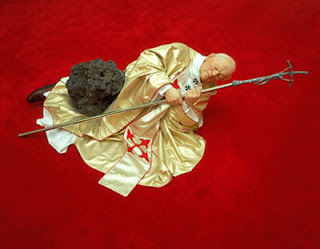
Copyright Maurizio Cattelan (1999) La Nona Ora
This hyperrealistic sculpture of the late Karol Woytila (Pope John Paul II) was created the same year Stanislaw Wielgus was named bishop of Plock (Plotzk)* by Pope John Paul II (a position Wielgus has held until his recent nomination as archbishop of Warsaw
The case of Stanislaw Wielgus shows the importance of a thorough workup of the political and theological reasons for his sudden downfall. There is little doubt that this man has been a loyal servant of both the late Karol Woytila (and his predecessor Jozef Glemp), in no way comparable to the sleeping mole Günther Guillaume that led to the downfall of German chancellor Willi Brandt. An ultraconservative throughout his carreer, Wielgus was probably the ideal go-between the communist regime and the growing power base of Karol Woytila and historical research will show if he has been a double-agent for both sides. The fact of the abrupt end of the carreer of an ultra-onservative cleric in Poland might be a signal of psychological hygiene in a country where transparency in power relationships has become possible nearly 20 years after the downfall of the socialist system in Eastern Europe - a historical evolution desired and actively supported by the catholic church of Poland - thanks to the integration of Poland into modern European relationships between church, state, media and science.
For the people of Poland it will be important to allow themselves a thorough scientific investigation of the mechanisms that a) have enabled the carreer of Stanislaw Wielgus and b) have led to the actual personal disaster.
Cf. Links:
a) Plock Official City Website (English Version)
b) Plotzk - An Ancient Jewish Community in Poland
On the history of the Jewish community of Plock which had existed from 1237 to 1941 when it was annihilated on March 1 (last vague of deportation during the Holocaust).

Copyright Maurizio Cattelan (1999) La Nona Ora
This hyperrealistic sculpture of the late Karol Woytila (Pope John Paul II) was created the same year Stanislaw Wielgus was named bishop of Plock (Plotzk)* by Pope John Paul II (a position Wielgus has held until his recent nomination as archbishop of Warsaw
The case of Stanislaw Wielgus shows the importance of a thorough workup of the political and theological reasons for his sudden downfall. There is little doubt that this man has been a loyal servant of both the late Karol Woytila (and his predecessor Jozef Glemp), in no way comparable to the sleeping mole Günther Guillaume that led to the downfall of German chancellor Willi Brandt. An ultraconservative throughout his carreer, Wielgus was probably the ideal go-between the communist regime and the growing power base of Karol Woytila and historical research will show if he has been a double-agent for both sides. The fact of the abrupt end of the carreer of an ultra-onservative cleric in Poland might be a signal of psychological hygiene in a country where transparency in power relationships has become possible nearly 20 years after the downfall of the socialist system in Eastern Europe - a historical evolution desired and actively supported by the catholic church of Poland - thanks to the integration of Poland into modern European relationships between church, state, media and science.
For the people of Poland it will be important to allow themselves a thorough scientific investigation of the mechanisms that a) have enabled the carreer of Stanislaw Wielgus and b) have led to the actual personal disaster.
Cf. Links:
a) Plock Official City Website (English Version)
b) Plotzk - An Ancient Jewish Community in Poland
On the history of the Jewish community of Plock which had existed from 1237 to 1941 when it was annihilated on March 1 (last vague of deportation during the Holocaust).
Monday, January 08, 2007
Le combat des reines - Calmy-Rey contre Royal
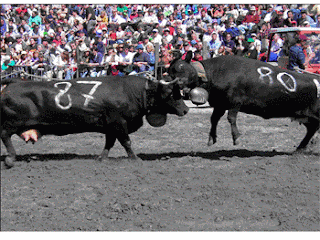
La présidente de la Confédération Suisse pour 2007 s'appelle Mme Micheline Calmy née Rey (en Espagnol, synonyme de "roi") et malgré le fait qu'elle soit socialiste, elle s'en est violemment prise à M. Montebourg, conseiller personnel de Mme Ségolène Royal, candidate socialiste à la présidence de la République Française, pour ses critiques du système fiscal suisse. Rey contre Royal, c'est un match qu'un peut considérer comme "un combat des reines". Ce terme a une signification toute particulière dans le Canton d'origine de Mme Calmy-Rey, le Valais, pays lourd de traditions paysannes et païennes. On dit qu'une partie de ce peuple montagnard, connu pour son esprit combattif et ses têtes dures, est issue de tribus berbères qui se seraient retirées dans les hautes vallées lors de la reconquête de l'Europe méridionale et des Alpes maritimes par les Chrétiens. Une des traditions importantes du Valais, à part la viticulture, c'est le "combat des reines", c.à.d. une série de concours entre vaches de la race d'Hérens (en Allemand "Eringer Vieh")qui sert à la sélection des cheffes de troupeau, avec une finale entre les plus fortes (les "reines") qui a lieu chaque année au moi d'avril.
Si on considère la controverse entre la reine socialiste helvétique et la reine socialiste française, les chances pour une victoire de la Valaisanne sont donc tout à fait réelles. Il y a pour ça non seulement une raison folklorique ou ethnopsychologique, mais une raison politique toute simple:
la France souffre depuis toujours de son centralisme à outrance, et l'appétit de l'Etat français de confisquer les biens des ces citoyens pour les redistribuer et pour décourager l'investissement privé n'est un secret our personne. On n'a pas oublié le cri de réprobation lorsque l'idole de la jeunessse des années soixante,
Johnny Halliday, a annoncé qu'il avait choisi la Suisse pour domicile pour des raisons fiscales. La France vivrait beaucoup plus heureuse et aurait beaucoup moins de difficultés d'investissements au niveau de l'infrastructure locale et de la ghettoisation de villes entières si elle se décidait de passer du centralisme bureaucratique à des solutions fédérales avec une compétition fiscale saine.
Il ne s'agit pas de glorifier le système ultrafédéraliste helvétique mais il faut admettre que la concurrence fiscale entre communes et Cantons a un effet très important sur la pensée économique des pouvoirs publics qui sont contraint à faire face à la perte de contribuables si elles n'arrivent pas à trouver un équilibre entre les besoins objectifs de la population et la charge fiscale. Le parti
socialiste suisse a fait, das le passé, et continue de le faire, des efforts considérables pour homogénéiser le régime fiscal, mais il risque d'être surpassé par des initiatives de la droite libérale qui tentent d'introduire une "flat tax" ou au moins und "flat rate tax" avec des taux d'imposition variant entre Communes et Cantons. Si la "reine" Micheline défend le fédéralisme helvétique, elle a une autre raison, plus simple. Elle aura, pour la présidence, besoin du Goodwill sait très des Cantons germanophones de Suisse occidentale (Zurich, Schaffhouse, Saint-Gall, Zoug, Grisons etc.) qui ont cultivés une aversion collective contre l'impéralisme et l'arrogance de la Grande Nation vis-à-vis des petits Suisses, depuis les temps de l'occupation française en 1798. On dirait qu'il persiste, en Suisse occidentale, une sorte d'esprit Vendéen de vengeance vis-à-vis du grand voisin.
Et une fois de plus, c'est une chance pour la petit nation de volonté à l'esprit "astérixien" au milieu de l'Europe de être habité non seulement par des germanophones, mais des francophones qui savent défendre leurs intérêts à la mode des vaches d'Hérens.

La présidente de la Confédération Suisse pour 2007 s'appelle Mme Micheline Calmy née Rey (en Espagnol, synonyme de "roi") et malgré le fait qu'elle soit socialiste, elle s'en est violemment prise à M. Montebourg, conseiller personnel de Mme Ségolène Royal, candidate socialiste à la présidence de la République Française, pour ses critiques du système fiscal suisse. Rey contre Royal, c'est un match qu'un peut considérer comme "un combat des reines". Ce terme a une signification toute particulière dans le Canton d'origine de Mme Calmy-Rey, le Valais, pays lourd de traditions paysannes et païennes. On dit qu'une partie de ce peuple montagnard, connu pour son esprit combattif et ses têtes dures, est issue de tribus berbères qui se seraient retirées dans les hautes vallées lors de la reconquête de l'Europe méridionale et des Alpes maritimes par les Chrétiens. Une des traditions importantes du Valais, à part la viticulture, c'est le "combat des reines", c.à.d. une série de concours entre vaches de la race d'Hérens (en Allemand "Eringer Vieh")qui sert à la sélection des cheffes de troupeau, avec une finale entre les plus fortes (les "reines") qui a lieu chaque année au moi d'avril.
Si on considère la controverse entre la reine socialiste helvétique et la reine socialiste française, les chances pour une victoire de la Valaisanne sont donc tout à fait réelles. Il y a pour ça non seulement une raison folklorique ou ethnopsychologique, mais une raison politique toute simple:
la France souffre depuis toujours de son centralisme à outrance, et l'appétit de l'Etat français de confisquer les biens des ces citoyens pour les redistribuer et pour décourager l'investissement privé n'est un secret our personne. On n'a pas oublié le cri de réprobation lorsque l'idole de la jeunessse des années soixante,
Johnny Halliday, a annoncé qu'il avait choisi la Suisse pour domicile pour des raisons fiscales. La France vivrait beaucoup plus heureuse et aurait beaucoup moins de difficultés d'investissements au niveau de l'infrastructure locale et de la ghettoisation de villes entières si elle se décidait de passer du centralisme bureaucratique à des solutions fédérales avec une compétition fiscale saine.
Il ne s'agit pas de glorifier le système ultrafédéraliste helvétique mais il faut admettre que la concurrence fiscale entre communes et Cantons a un effet très important sur la pensée économique des pouvoirs publics qui sont contraint à faire face à la perte de contribuables si elles n'arrivent pas à trouver un équilibre entre les besoins objectifs de la population et la charge fiscale. Le parti
socialiste suisse a fait, das le passé, et continue de le faire, des efforts considérables pour homogénéiser le régime fiscal, mais il risque d'être surpassé par des initiatives de la droite libérale qui tentent d'introduire une "flat tax" ou au moins und "flat rate tax" avec des taux d'imposition variant entre Communes et Cantons. Si la "reine" Micheline défend le fédéralisme helvétique, elle a une autre raison, plus simple. Elle aura, pour la présidence, besoin du Goodwill sait très des Cantons germanophones de Suisse occidentale (Zurich, Schaffhouse, Saint-Gall, Zoug, Grisons etc.) qui ont cultivés une aversion collective contre l'impéralisme et l'arrogance de la Grande Nation vis-à-vis des petits Suisses, depuis les temps de l'occupation française en 1798. On dirait qu'il persiste, en Suisse occidentale, une sorte d'esprit Vendéen de vengeance vis-à-vis du grand voisin.
Et une fois de plus, c'est une chance pour la petit nation de volonté à l'esprit "astérixien" au milieu de l'Europe de être habité non seulement par des germanophones, mais des francophones qui savent défendre leurs intérêts à la mode des vaches d'Hérens.
Friday, December 22, 2006
Piergiorgio Welby
Piergiorgio Welby is dead. He died because his physicians honoured his clear will to end his life that had become intolerable for him in the natural course of degenerative disease of the neuromuscular system for which there is no cure so far. They cut off the artificial ventilation that had maintained his failing respiration.
Conventional medical ethics demand the maintenance of life support as long as a patient ist not brain-dead, on the basis of the assumption that a cure for the disease responsible for the failure of physiological functions might be available in a foreseeable future. In the conscious patient with a chronic condition which steadily continues to deteriorate, the situation is different. Even if there is non cure in sight, some, but not all patients with similar conditions are able to adapt to their situation (tetraplegics, but also some persons with degenerative neuromuscular disease, such as famous astrophysicist Stephen Hawking). What if a patient is uncapable in the long run to cope mentally with her/his condition? Is it correct to view the decision to commit suicide per se as the result of a pathological process that could be treated successfully, e.g. depression?
Where are the limits of coercion that can be used in order to maintain life when a fully conscious person, capable of reasoning, clearly declares that she/he is no longer willing to undergo the treatment imposed by the failure of her/his physiological functions? Where is the line between a treatement that is lived as torture by the patient and the obligation of the health care provider to respect
codified ethics and legal rules?
These questions are now raised in Italy and will produce a useful debate on the responsibility of legislators in medical and bio-ethics, as well as the responsibility of the individual health care provider and the freedom of choice of the conscious patient. The outcome of the debate will show us if respect for the individual person is strong enough to block attempts by fundamentalist religious authorities and political movements to enforce therapies that eventually become equivalents of torture.
Piergiorgio Welby is dead. He died because his physicians honoured his clear will to end his life that had become intolerable for him in the natural course of degenerative disease of the neuromuscular system for which there is no cure so far. They cut off the artificial ventilation that had maintained his failing respiration.
Conventional medical ethics demand the maintenance of life support as long as a patient ist not brain-dead, on the basis of the assumption that a cure for the disease responsible for the failure of physiological functions might be available in a foreseeable future. In the conscious patient with a chronic condition which steadily continues to deteriorate, the situation is different. Even if there is non cure in sight, some, but not all patients with similar conditions are able to adapt to their situation (tetraplegics, but also some persons with degenerative neuromuscular disease, such as famous astrophysicist Stephen Hawking). What if a patient is uncapable in the long run to cope mentally with her/his condition? Is it correct to view the decision to commit suicide per se as the result of a pathological process that could be treated successfully, e.g. depression?
Where are the limits of coercion that can be used in order to maintain life when a fully conscious person, capable of reasoning, clearly declares that she/he is no longer willing to undergo the treatment imposed by the failure of her/his physiological functions? Where is the line between a treatement that is lived as torture by the patient and the obligation of the health care provider to respect
codified ethics and legal rules?
These questions are now raised in Italy and will produce a useful debate on the responsibility of legislators in medical and bio-ethics, as well as the responsibility of the individual health care provider and the freedom of choice of the conscious patient. The outcome of the debate will show us if respect for the individual person is strong enough to block attempts by fundamentalist religious authorities and political movements to enforce therapies that eventually become equivalents of torture.
Wednesday, December 20, 2006
Le jugement de Tripoli - Une "affaire Calas" en Libye?
Le jugement de Tripoli (cinq infirmières bulgares et un médecin palestinien condammnés à la mort pour le présumé crime d'avoir infecté des enfants d'un hôpital de Bengasi avec le HIV) évoque la mémoire de l'accusation lancée par Voltaire auf 18e siècle au sujet de l'affaire Calas à Toulouse. On espère pour ces condamnés mais aussi pour la Libye toute entière l'entrée en scène d'un Voltaire autochthone qui aurait le courage de défier les perversion du système judiciare en place et de faire corriger ce jugement catastrophique.
Le jugement de Tripoli (cinq infirmières bulgares et un médecin palestinien condammnés à la mort pour le présumé crime d'avoir infecté des enfants d'un hôpital de Bengasi avec le HIV) évoque la mémoire de l'accusation lancée par Voltaire auf 18e siècle au sujet de l'affaire Calas à Toulouse. On espère pour ces condamnés mais aussi pour la Libye toute entière l'entrée en scène d'un Voltaire autochthone qui aurait le courage de défier les perversion du système judiciare en place et de faire corriger ce jugement catastrophique.
Claudio Magris and the "Lumpenbürgertum"
Claudio Magris, in an interview with the Neue Zürcher Zeitung (december 20, 2006), has an interesting definition for the followers of former Italian Prime Minister Silvio Berlusconi:
"Lumpenbürgertum". The term is apparently derived from "Lumpenproletariat" (Russian:
Люмпенпролетариата), which in classical Marxist terminology describes the dispossessed masses "without class consciousness", which are therefore considered as useless for the systematic buildup of a revolutionary movement. The terminology suggested by Claudio Magris deserves some reflexion: first, the perception of the "Lumpenbürgertum" as a mass without "class consciousness" may be biased. The followers of Silvio Berlusconi are proud to consider themselves as the elite of postmodern liberalism, even if their conception of liberalism may be closer to mafiose ethics than to classical liberal thinking.
On the other hand, from a post-communist and post-fascist point of view, the masses may very well serve a revolutionary cause, but in a quite different way than Marx thought.
The "Lumpenproletariat" and the "Lumpenbürgertum" or "Lumpenbourgeoisie"
(Russian: ЛюмпенБуржуазии ) has been useful on various occasions during the 20th century for the orchestration of "coups d'état" (German: Staatsstreich, Spanish: golpe, Italian: colpo di stato). A colleague of Claudio Magris, Curzio Malaparte,
described the technique of the coup d'état in his famous book "tecnica del colpo di stato" back in 1931. The author describes the power struggle within the Russian revolution that led to Stalin's dictatorial regime, the methods used by Mussolini to get into control of Italy, and predicts the success of Hitler in Germany. At that time Malaparte is convinced that Hitler is a "particularly intelligent communist". The book has been published first in France, and then in Vienna, to be immediately forbidden in fascist Italy and in Nazi Germany. It is still recommended for those who like to look at history from different angles.
A modern edition of "tecnica del colpo di stato" has been published under the direction of the actual chief of the historical service of the Foreign Office (servizio storico del ministero degli esteri) of the Repubblica Italiana, Francesco Perfetti, at Mondadori, in 2003.
If we combine the terminology of Claudio Magris with the Malaparte's observations, the conclusion that Silvio Berlusconi has been (or still is) an admirer of Malaparte's tecnica del colpo di stato and that his most important personal success may be to have awakened the consciousness of his fellow citizens of the possibility of a colpo di stato within the framework of a democracy...
Claudio Magris, in an interview with the Neue Zürcher Zeitung (december 20, 2006), has an interesting definition for the followers of former Italian Prime Minister Silvio Berlusconi:
"Lumpenbürgertum". The term is apparently derived from "Lumpenproletariat" (Russian:
Люмпенпролетариата), which in classical Marxist terminology describes the dispossessed masses "without class consciousness", which are therefore considered as useless for the systematic buildup of a revolutionary movement. The terminology suggested by Claudio Magris deserves some reflexion: first, the perception of the "Lumpenbürgertum" as a mass without "class consciousness" may be biased. The followers of Silvio Berlusconi are proud to consider themselves as the elite of postmodern liberalism, even if their conception of liberalism may be closer to mafiose ethics than to classical liberal thinking.
On the other hand, from a post-communist and post-fascist point of view, the masses may very well serve a revolutionary cause, but in a quite different way than Marx thought.
The "Lumpenproletariat" and the "Lumpenbürgertum" or "Lumpenbourgeoisie"
(Russian: ЛюмпенБуржуазии ) has been useful on various occasions during the 20th century for the orchestration of "coups d'état" (German: Staatsstreich, Spanish: golpe, Italian: colpo di stato). A colleague of Claudio Magris, Curzio Malaparte,
described the technique of the coup d'état in his famous book "tecnica del colpo di stato" back in 1931. The author describes the power struggle within the Russian revolution that led to Stalin's dictatorial regime, the methods used by Mussolini to get into control of Italy, and predicts the success of Hitler in Germany. At that time Malaparte is convinced that Hitler is a "particularly intelligent communist". The book has been published first in France, and then in Vienna, to be immediately forbidden in fascist Italy and in Nazi Germany. It is still recommended for those who like to look at history from different angles.
A modern edition of "tecnica del colpo di stato" has been published under the direction of the actual chief of the historical service of the Foreign Office (servizio storico del ministero degli esteri) of the Repubblica Italiana, Francesco Perfetti, at Mondadori, in 2003.
If we combine the terminology of Claudio Magris with the Malaparte's observations, the conclusion that Silvio Berlusconi has been (or still is) an admirer of Malaparte's tecnica del colpo di stato and that his most important personal success may be to have awakened the consciousness of his fellow citizens of the possibility of a colpo di stato within the framework of a democracy...
Saturday, December 16, 2006
Will Swiss physicians opt for the health care kolkhoz?
The Neue Zürcher Zeitung NZZ reports today that the Swiss Medical Federation FMH has decided not to take sides in the vote on the socialist health insurance initiative due next spring.
By leaving the decision to the members, the FMH abandons definitely the defense of the liberal traditions of the medical profession. It is evident that one of the central motives for doctors to opt for a centralized federal health insurance scheme is their growing anger about the unreliable, inconstant and mostly aggressive politics of the various social insurance companies active in Switzerland under the umbrella of heavy federal and cantonal legislation.
Another probable motive is a change of paradigm in the autostereotype of the medical profession. Many young physicians no longer can imagine to engage in an independent and entrepreneurial professional activity.
Once they leave the hospital environment where they have become accustomed to be employees - mostly at an age where they are married with children and anxiously avoid professional reiks, they are often seduced by the possibility of entering into a so-called "tiers payant" relationship with the social insurance companies, under a contract where there is no need to ask payment from their patients, an where they can relay on payment by the insurance company. The tradition of the "tiers garant" system that had strengthened the relationship between primary care (and specialized) physicians and their patients by allowing direct comparison between price and performance, with payback by the insurance company to the patent has become shaky. It was the "tiers garant" method that allowed direct control of price and quality by the client, but since this system no longer exists in hospital treatment, young physicians are no longer prepared to enforce it.
As an economic editorial in the Neue Zürcher Zeitung a year ago said: "Before WTO, the Federal Constution had to guarantee the health of the farming profession, after WTO the Constitution might have to guarantee the health of the medical profession..."
Back in the Soviet Union, independent farmers, the so-called kulaks, were forced into the kolkhoz system of collective farming. It is one of the paradoxes of our era, that twenty years after the downfall of the Soviet system, Swiss farmers seriously prepare temselves to find their economic niche under the conditions of globalisation, and Swiss physicians increasingly lean toward collectivistic solutions of the healthcare system.
The crucial question is whether a majority of physicians will be tempted to seek shelter under an umbrella that would be a late imitation of the NHS in Britain, at a time when even in countries with a longstanding socialist tradition, there is a continuous shift away from state-controlled financing of the health care system.
The Neue Zürcher Zeitung NZZ reports today that the Swiss Medical Federation FMH has decided not to take sides in the vote on the socialist health insurance initiative due next spring.
By leaving the decision to the members, the FMH abandons definitely the defense of the liberal traditions of the medical profession. It is evident that one of the central motives for doctors to opt for a centralized federal health insurance scheme is their growing anger about the unreliable, inconstant and mostly aggressive politics of the various social insurance companies active in Switzerland under the umbrella of heavy federal and cantonal legislation.
Another probable motive is a change of paradigm in the autostereotype of the medical profession. Many young physicians no longer can imagine to engage in an independent and entrepreneurial professional activity.
Once they leave the hospital environment where they have become accustomed to be employees - mostly at an age where they are married with children and anxiously avoid professional reiks, they are often seduced by the possibility of entering into a so-called "tiers payant" relationship with the social insurance companies, under a contract where there is no need to ask payment from their patients, an where they can relay on payment by the insurance company. The tradition of the "tiers garant" system that had strengthened the relationship between primary care (and specialized) physicians and their patients by allowing direct comparison between price and performance, with payback by the insurance company to the patent has become shaky. It was the "tiers garant" method that allowed direct control of price and quality by the client, but since this system no longer exists in hospital treatment, young physicians are no longer prepared to enforce it.
As an economic editorial in the Neue Zürcher Zeitung a year ago said: "Before WTO, the Federal Constution had to guarantee the health of the farming profession, after WTO the Constitution might have to guarantee the health of the medical profession..."
Back in the Soviet Union, independent farmers, the so-called kulaks, were forced into the kolkhoz system of collective farming. It is one of the paradoxes of our era, that twenty years after the downfall of the Soviet system, Swiss farmers seriously prepare temselves to find their economic niche under the conditions of globalisation, and Swiss physicians increasingly lean toward collectivistic solutions of the healthcare system.
The crucial question is whether a majority of physicians will be tempted to seek shelter under an umbrella that would be a late imitation of the NHS in Britain, at a time when even in countries with a longstanding socialist tradition, there is a continuous shift away from state-controlled financing of the health care system.
Sunday, December 03, 2006
Minarets in Switzerland - Grey Wolves and Grey Bears
The debate on whether minarets are good or bad in Switzerland should
not be left to the extreme right of both Turkey and Switzerland
A legal row over the permission to build a minaret between a
Turkish Cultural Association which is said to be related to the
extreme right nationalist group "Grey Wolves" and the local political
authorities of the municipality of Wangen near Olten in the Swiss-
German Canton Solothurn has now evolved into a major subject for a
group of political activists within the Swiss People's Party, to be used in the federal parliamentary election year 2007.
The major arguments brought forward against minarets in Switzerland are the
following:
a) Minarets could transform traditional architectural
structures, often protected historical monuments, among them, and
particularly prominent, churches, some of them built even more than
1200 years ago. Minarets would present a menace to the cultural
tradition of the country. This argument is most strongly present in
the Italian-speaking Canton of Ticino with it's impressive
"Campanile" with their characteristic stone roofs, often standing
alone beside a rather modest basilica or chapel. Resistance against the constructions of minarets is strong here on the aforementionned grounds
b) Minarets should not be permitted because they represent the
religious fundamentalism, aggressivity and intolerance that has been associated lately with the Muslim world in general, as a consequence of the rhetoric of fundamentalist groups within Islam. This argument is probably the one most often brought forward
c) the minaret of Wangen is considered to be a religious pretext for implanting
extremist, probably terrorism-prone political organization. This is the argument used by the local opponents to the project.
d) A mosque is a Mosque even without a minaret (in fact there are historical mosques without the characteristic stiletto type minaret, e.g. in Africa, as the picture of a Sankore mosque in Timbuktu shows)

Source: Road to Timbuktu
http://www.pbs.org/wonders/Episodes/Epi5/5_wondr6.htm
The real problem lies in the nature of the exponents of both sides.
The Turkish nationalist extreme right (the Grey Wolves) has been
known for decades for it's violence-prone rhetoric and behavior.
On the opposite side, in Switzerland, Ulrich Schlüer, member of the group most active in the fight against minarets (the "Egerkinger Gruppe") - let us call them
"Grey Bears" - has been known for years for his inflammatory
nationalist rhetoric. This type of rhetoric rhetoric easily creates an
atmosphere of confrontation where words facilitate the use of fists by frustrated citizens, and eventually of knives, guns and/or explosives, which in turn would justify heavy police intervention.
In the long term, an authoritarian regime , e.g. of the type of Mr
Putin's ideal: "Dictatorship of the Law", might be the consequence.
It is not known if Mr Schlüer has ever been to the Middle East or
to Northern Ireland, where there is overwhelming evidence for the
devastating consequences of a systematic build-up of violence through
violent rhetoric. It is difficult to imagine that Mr Schlüer really
desires this type of political climate in Switzerland, but the public still
waits for a formal dementi.
During the wars in Former Yugoslavia (Croatia, Serbia, Bosnia, Kosovo) systematic mutual destruction of cultural heritage was
an important method of "cultural genocide", as the images below of two destroyed churches in Vukovar (Croatia),of two mosques in Stolac (Bosnia) and of the title page of a book on "Spiritual Genocide" testify:


These destructions are the concrete results of a longterm, unrestrained, uninterrupted and systematic mutual discriminatory discourse
A reminder: In Zurich-Balgrist,a mosque with a minaret that had been built 43 years ago lies peacefully next to the evangelic-reformed (protestant) church.
The debate on whether minarets are good or bad in Switzerland should
not be left to the extreme right of both Turkey and Switzerland
A legal row over the permission to build a minaret between a
Turkish Cultural Association which is said to be related to the
extreme right nationalist group "Grey Wolves" and the local political
authorities of the municipality of Wangen near Olten in the Swiss-
German Canton Solothurn has now evolved into a major subject for a
group of political activists within the Swiss People's Party, to be used in the federal parliamentary election year 2007.
The major arguments brought forward against minarets in Switzerland are the
following:
a) Minarets could transform traditional architectural
structures, often protected historical monuments, among them, and
particularly prominent, churches, some of them built even more than
1200 years ago. Minarets would present a menace to the cultural
tradition of the country. This argument is most strongly present in
the Italian-speaking Canton of Ticino with it's impressive
"Campanile" with their characteristic stone roofs, often standing
alone beside a rather modest basilica or chapel. Resistance against the constructions of minarets is strong here on the aforementionned grounds
b) Minarets should not be permitted because they represent the
religious fundamentalism, aggressivity and intolerance that has been associated lately with the Muslim world in general, as a consequence of the rhetoric of fundamentalist groups within Islam. This argument is probably the one most often brought forward
c) the minaret of Wangen is considered to be a religious pretext for implanting
extremist, probably terrorism-prone political organization. This is the argument used by the local opponents to the project.
d) A mosque is a Mosque even without a minaret (in fact there are historical mosques without the characteristic stiletto type minaret, e.g. in Africa, as the picture of a Sankore mosque in Timbuktu shows)

Source: Road to Timbuktu
http://www.pbs.org/wonders/Episodes/Epi5/5_wondr6.htm
The real problem lies in the nature of the exponents of both sides.
The Turkish nationalist extreme right (the Grey Wolves) has been
known for decades for it's violence-prone rhetoric and behavior.
On the opposite side, in Switzerland, Ulrich Schlüer, member of the group most active in the fight against minarets (the "Egerkinger Gruppe") - let us call them
"Grey Bears" - has been known for years for his inflammatory
nationalist rhetoric. This type of rhetoric rhetoric easily creates an
atmosphere of confrontation where words facilitate the use of fists by frustrated citizens, and eventually of knives, guns and/or explosives, which in turn would justify heavy police intervention.
In the long term, an authoritarian regime , e.g. of the type of Mr
Putin's ideal: "Dictatorship of the Law", might be the consequence.
It is not known if Mr Schlüer has ever been to the Middle East or
to Northern Ireland, where there is overwhelming evidence for the
devastating consequences of a systematic build-up of violence through
violent rhetoric. It is difficult to imagine that Mr Schlüer really
desires this type of political climate in Switzerland, but the public still
waits for a formal dementi.
During the wars in Former Yugoslavia (Croatia, Serbia, Bosnia, Kosovo) systematic mutual destruction of cultural heritage was
an important method of "cultural genocide", as the images below of two destroyed churches in Vukovar (Croatia),of two mosques in Stolac (Bosnia) and of the title page of a book on "Spiritual Genocide" testify:


These destructions are the concrete results of a longterm, unrestrained, uninterrupted and systematic mutual discriminatory discourse
A reminder: In Zurich-Balgrist,a mosque with a minaret that had been built 43 years ago lies peacefully next to the evangelic-reformed (protestant) church.
Thursday, November 30, 2006
Swiss Think Tanks Speak Out
In a Thursday, 30 November 2006 "Ideas Fair" at Technopark Zurich, the Swiss political think tanks Avenir Suisse (i.e. "Swiss Future", group headed by Thomas HELD) and Liberales Institut(Robert NEF), together with a dozen groups with similar activities, presented their concepts for initiating political and economical reform in Switzerland. Among the central subjects discussed was the question why Switzerland is so much behind schedule - in contrast to many countries in Europe with a heavy socialist tradition - when it comes to break down state monopolies.
It was found that the multi-layer federalist system demands extremely fine-tuned long-term campaigning in order to win the confidence of voters. Political analyst Claude Longchamps pointed to example of the popular vote in 2004 on stem cell legislation - the most liberal in Europe - for the sometimes excellent results of a more technically than politically inspired campaigning. Martine Brunschwig-Graf, a liberal Congresswoman from Geneva, called for a serious effort to define liberalism as a "state of the mind" and for more encouragement for individual citizen to take risks, to succeed or to fail without beeing punished by rigid regulations.
There were calls for serene optimism for the national elections of 2007 among warnings of a slow but inexorable decline of the welfare state into general depression. It was a meeting that clearly showed the enormous difficulties to implement change in a system full of perfectly interconnected stakeholders on every possible level of political decisionmaking.
One participant privately talked of "Leibeigenschaft im Sozialstaat" ("wellfare state slavery")...
In a Thursday, 30 November 2006 "Ideas Fair" at Technopark Zurich, the Swiss political think tanks Avenir Suisse (i.e. "Swiss Future", group headed by Thomas HELD) and Liberales Institut(Robert NEF), together with a dozen groups with similar activities, presented their concepts for initiating political and economical reform in Switzerland. Among the central subjects discussed was the question why Switzerland is so much behind schedule - in contrast to many countries in Europe with a heavy socialist tradition - when it comes to break down state monopolies.
It was found that the multi-layer federalist system demands extremely fine-tuned long-term campaigning in order to win the confidence of voters. Political analyst Claude Longchamps pointed to example of the popular vote in 2004 on stem cell legislation - the most liberal in Europe - for the sometimes excellent results of a more technically than politically inspired campaigning. Martine Brunschwig-Graf, a liberal Congresswoman from Geneva, called for a serious effort to define liberalism as a "state of the mind" and for more encouragement for individual citizen to take risks, to succeed or to fail without beeing punished by rigid regulations.
There were calls for serene optimism for the national elections of 2007 among warnings of a slow but inexorable decline of the welfare state into general depression. It was a meeting that clearly showed the enormous difficulties to implement change in a system full of perfectly interconnected stakeholders on every possible level of political decisionmaking.
One participant privately talked of "Leibeigenschaft im Sozialstaat" ("wellfare state slavery")...
Ποντίφικα επίσκεψη στην Κωνσταντινούπολη - Papa İstanbul trafiğini kilitledi
The following text has been found on the Turkish TV Channel ATV
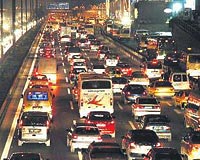
Papa 16. Benedict'in İstanbul'u ziyareti sırasında yolların güvenlik nedeniyle kapatılması vatandaşa zor anlar yaşattı Tam anlamıyla arapsaçına dönen trafikte araçlarında uzun süre mahsur kalan İstanbullular saatler sonra yollarına devam edebildi
Simultaneously, Greek National TV reports as follows:
Είκοσι εφτά χρόνια μετά την τελευταία Ποντίφικα επίσκεψη στην Κωνσταντινούπολη, ο Πάπας Βενέδικτος ΙΣΤ έγινε θερμά δεκτός στο Φανάρι από τον Οικουμενικό Πατριάρχη Βαρθολομαίο. Σε μια ιστορική στιγμή για την πολυπόθητη ενότητα των εκκλησιών, οι κορυφαίοι πνευματικοί ηγέτες εκατομμυρίων πιστών συναντήθηκαν στην έδρα του Οικουμενικού Θρόνου. Προηγουμένως οι δυο θρησκευτικοί ηγέτες παρακολούθησαν μαζί τη δοξολογία στον Πατριαρχικό Ναό του Αγίου Γεωργίου, προσκύνησαν από κοινού τα λείψανα των Αγίων Γρηγορίου του Θεολόγου και Ιωάννου του Χρυσοστόμου, και αντάλλαξαν θερμούς λόγους με την ευκαιρία του ιστορικού γεγονότος
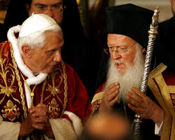
Some 27 years after the last time a Pontiff had visited Istanbul, once known as Constantinople, Pope Benedict XVI was warmly welcomed Wednesday evening in Phanar by Ecumenical Patriarch Bartholomew-"first among equals" of the leaders of the Orthodox Christian churches. In a landmark moment for the much-anticipated reconciliation of the two Churches, the spiritual leaders of millions of Christians held talks at the seat of the Ecumenical Patriarchate. Earlier, they had attended a mass at the Patriarchal Church of St. George, bowed to the holy relics of Saints John Chrysostom and Gregory and exchanged warm greetings on the occasion of such a momentous event.
It is comforting to see that for Turkey, the papal visit caused more problems on a practical (traffic) level than on religious grounds, whereas the relationship between
East and West Rome appeared to be more complex. The english translation of the Greek text contains a description of the Orthodox Patriarch which is not mentionned in the original: "first among equals". Has the english translation been manipulated for the use of those who do not understand Greek, in order to mark the difference of hierarchical status of the two church leaders?
Whatever the reasons for these linguistic contorsions, the most impressing phenomenon during the formal meeting, as shown on Greek TV, was the contrast between the impressive and wellarticulated, musical voice of Patriarch Batholomew and the thin voice and heavy German accent in the response (in English) of the Pope.
The following text has been found on the Turkish TV Channel ATV
Papa 16. Benedict'in İstanbul'u ziyareti sırasında yolların güvenlik nedeniyle kapatılması vatandaşa zor anlar yaşattı Tam anlamıyla arapsaçına dönen trafikte araçlarında uzun süre mahsur kalan İstanbullular saatler sonra yollarına devam edebildi

Simultaneously, Greek National TV reports as follows:
Είκοσι εφτά χρόνια μετά την τελευταία Ποντίφικα επίσκεψη στην Κωνσταντινούπολη, ο Πάπας Βενέδικτος ΙΣΤ έγινε θερμά δεκτός στο Φανάρι από τον Οικουμενικό Πατριάρχη Βαρθολομαίο. Σε μια ιστορική στιγμή για την πολυπόθητη ενότητα των εκκλησιών, οι κορυφαίοι πνευματικοί ηγέτες εκατομμυρίων πιστών συναντήθηκαν στην έδρα του Οικουμενικού Θρόνου. Προηγουμένως οι δυο θρησκευτικοί ηγέτες παρακολούθησαν μαζί τη δοξολογία στον Πατριαρχικό Ναό του Αγίου Γεωργίου, προσκύνησαν από κοινού τα λείψανα των Αγίων Γρηγορίου του Θεολόγου και Ιωάννου του Χρυσοστόμου, και αντάλλαξαν θερμούς λόγους με την ευκαιρία του ιστορικού γεγονότος

Some 27 years after the last time a Pontiff had visited Istanbul, once known as Constantinople, Pope Benedict XVI was warmly welcomed Wednesday evening in Phanar by Ecumenical Patriarch Bartholomew-"first among equals" of the leaders of the Orthodox Christian churches. In a landmark moment for the much-anticipated reconciliation of the two Churches, the spiritual leaders of millions of Christians held talks at the seat of the Ecumenical Patriarchate. Earlier, they had attended a mass at the Patriarchal Church of St. George, bowed to the holy relics of Saints John Chrysostom and Gregory and exchanged warm greetings on the occasion of such a momentous event.
It is comforting to see that for Turkey, the papal visit caused more problems on a practical (traffic) level than on religious grounds, whereas the relationship between
East and West Rome appeared to be more complex. The english translation of the Greek text contains a description of the Orthodox Patriarch which is not mentionned in the original: "first among equals". Has the english translation been manipulated for the use of those who do not understand Greek, in order to mark the difference of hierarchical status of the two church leaders?
Whatever the reasons for these linguistic contorsions, the most impressing phenomenon during the formal meeting, as shown on Greek TV, was the contrast between the impressive and wellarticulated, musical voice of Patriarch Batholomew and the thin voice and heavy German accent in the response (in English) of the Pope.
Subscribe to:
Posts (Atom)